lördag 6 september 2014

Getting it to fit


The cast aluminum S-G intakes (for NDIX on Okrasa heads) are a bit chunkier than the steel ones used on the original kit with 32 PBIC. This is very noticeable during assembly.

This is what I had to do (so far) to fit them:
  1. Shorten the "overhang" from the mid-upper 25 hp head studs a few millimeters.
  2. Cut large holes in the cylinder tin on free-hand. (They now look OK assembled, I chose to fold in the sheet metal a bit for a nice snug fit)
  3. Use special M8 flange nuts with 10 mm external hex fitting (from Dalhems, Vessigebro).
  4. Grind in a few places on the intakes (they are thick, so it's no problem)
As the inner head-to-inkake nut is within the fan shroud the intakes can't hardly be assembled when the engine is in the car (also the intake need to be put into the cylinder tin before putting it to the engine). I hope it will be possible to get the engine in the bay with the intakes still on. It "should" be possible.

I'll keep you posted.

onsdag 3 september 2014

The thermostat


When it was time to assemble the thermostat I realized there was no room for the rod through the Okrasa heads. After consulting friends with Okrasa knowledge the simple answer was that they were meant to be run without a thermostat.

As I have learnt that the thermostat is important and you shouldn't remove it I got a bit doubtful. First thing to check: What about the 356 engine? Well, it seems as Porsche didn't use a thermostat either. Later models had one for letting warm air into the air filters when the surrounding temperature was below 23-24 degrees Celsius, but that's a totally different thing.

I guess the design rational behind it was that a VW owner saw his car as a workhorse and expected it to be ready for full use from the start. The Porsche owner was probably perceived as being a bit more understanding about the need to warm up the engine before putting load to it. Thus a thermostat was not that important. The same reasoning could also be used to explain why VW's had choke and the Porsche didn't.

Whatever it is I have taken the bold decision to run my engine without thermostat. I promise I will let the S-engine warm up properly before torturing it.

Above you see close-ups of the Okrasa and the stock heads. The latter has a nice passage for the rods where Okrasa has longer cooling fins instead.


lördag 30 augusti 2014

Paus-speedster


Kan inte undanhålla er denna Porsche Speedster med ekerhjul och hal hardtop. Underbar!

Från Christophorus Magazine, #44, March 1963

söndag 24 augusti 2014

Valfläsk


På tal om nyss nämnda bloggkollega: Niklas var tidigt ute i valkampanjen, redan i våras försåg han mig med kampanjmaterial som nu återfinns på min Ghia.

Niklas blogg finns på: http://luftkyld.blogspot.se

tisdag 19 augusti 2014

Lowlight på Roskilde ring

Bloggkollegan Niklas tipsade mig om att det fanns trevliga Ghiabilder på Roskilde Rings facebookgrupp. Mycket riktigt, där finner man en stilig lowlight i tävlingsutförande, det vill säga: Minus navkapslar, plus extraljus och stor kromad tuta. Den är i gott sällskap med en 356A och en ovalruta. Kan vi gissa att bilden är tagen tidigt 60-tal?

Vi tar en bild till för att njuta av att VW'n håller en Simca Aronde stången på Roskilde Ring. Simcan hade 1300 cc och 48 hästar i original, men vägde något mer. Ghian var gissningsvis bättre i kurvorna och om motorn var trimmad borde den franska sedanen inte utgjort något större problem.

Tack till Vagn N för lånet av bilderna!


lördag 16 augusti 2014

Torque specifications.


Now the assembly of the long block has begun. As you can see  I have chosen to leave the surface of the case as-is to get an "old" look. One thing to pay extra attention to is the torque specifications. The design of the Okrasa heads makes them weak around the upper middle section, thus normal torque specs shouldn't be followed.

I have two sets of instructions for the Okrasa engines, one in English, probably written in 1957 at the time when the TSV1300 was launched. The other one is a German installation manual for Okrasa exchange engines from around 1963. The interesting thing is that the torque spec differ a lot*. See below:

Okrasa English c:a 1957: 2.5 - 2.7 MKg for the upper middle, 2.7 - 2.8 MKg for the rest.
Okrasa German c:a 1963: : 3,3 - 3.5 mkg for the four upper and 3,4 - 3,6 for the lower.
Stock 30/36 hp spec: 3,6 - 3,8 kpm for all
Stock 34/40 hp spec: 3,2 kpm

One observation is that the torque for stock 30/36 hp engines is much higher than for the stock 34/40 hp. My guess is that the extra torque goes into the crushing of the copper gasket. This gasket is only an extra safety measure to avoid exhaust to leak into the heating system and have no other technical function. If the seal between head and cylinder is in good shape there is no need for it. For the newer engine type this gasket was removed.

As my intention is to have a properly built engine in good shape I chose to remove this gasket. I see no point in putting extra stress on the Okrasa heads by having this copper ring (or risking not to seat the cylinders properly if the torque is not enough to crush the rings).

So what torque to use? As the clamp force derived from an applied tightening torque is very much dependent on friction (approx. 90% of the torque goes into friction and only about 10% is actually providing useful clamp force), you really don't know what you end up with anyway. My intention is to get the friction reasonable low and to use the higher torque figure from the older Okrasa instructions. It's guesswork, but as a home-mechanics I can't make any deeper investigations.

*I have written the units exactly as my sources. To make it clear: 1 MKg = 1 mkg = 1 kpm = 9,8 Nm

torsdag 7 augusti 2014

Wiking Autorennen: Målgång och grill

Start och målgång för loppet skedde hos Kuus och Angelica i Rättvik. Där pågick samtidigt en veckolång VW camping kallad Rat Bay #7. Så vid prisutdelning och grillning träffades de bägge VW falangerna (buss camparna och old-speed fantasterna) samtidigt som det droppade in diverse bilar från Classic Car Week cruisingen som pågick precis utanför.
Här är ett exempel på ett gäng i VW-camping-kategorin med stilren 70-talsorange Ockelbo-buss.


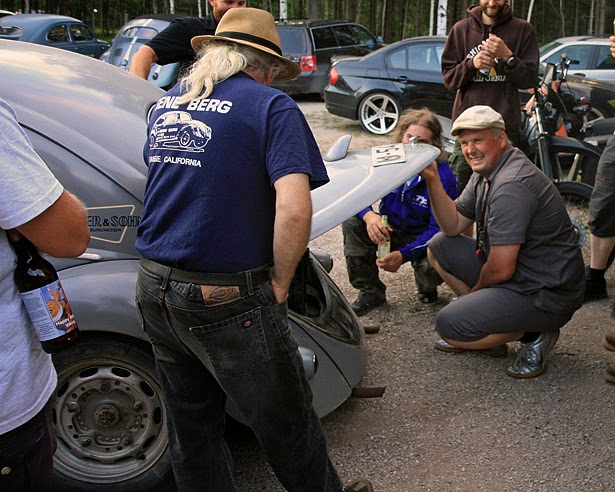
Øystein kom på kvällen och inspekterade sin bil. Fez var lite orolig då bilen hade, låt oss säga, samlat på sig en hel del erfarenheter under rallyt och en tidigare backtävling. Øystein (i keps på bilden) verkade dock inte så bekymrad.

Sedan var det återigen dags för Danne att ropa till sig massorna för att hylla pristagarna.


Fez bekymrade min försvann när det stod klart att han hade snabbaste tiden på specialsträcka 3.


Rallyts totalsegrare blev Bengt som hade jämnast tid till, respektive från, Ljusdal. Stort grattis!


Under kvällen dök detta gamla svenska hembygge upp. Jag hann bara prata kort med ägaren, men skulle gärna vilja veta mer!
Med den grå spliten utlånad dök Øystein upp i sin Hebmüller coupé. En replika av en bil som aldrig hann byggas innan fabriken brann ned.


Det blev ett par omgångar på grillen och en massa VW prat. Någon idé att åka därifrån var det knappast då cruisingen korkat igen hela sta'n.